Gut-Brain Communication: Digestion and Vagal Signaling
Affiliate links are included in this blog. If you make a purchase using these links, I might earn a small commission at no extra cost to you. Win-Win!
If you’ve ever had “butterflies in your stomach” before a big event or noticed your digestion shut down during stress, you’ve felt the gut-brain connection in action. The messenger behind this connection is the vagus nerve, the body’s longest cranial nerve and the main communication highway between your digestive system and your brain.
When vagal tone (the strength and flexibility of vagus signaling) is healthy, digestion feels smooth, the gut microbiome thrives, and the brain receives calming, steady feedback. When vagal tone is low or imbalanced, the conversation breaks down, and problems like IBS, reflux, and even inflammatory bowel conditions often follow.
The Gut-Brain Axis Explained
The vagus nerve is the direct link in what scientists refer to as the gut-brain axis. Up to 90% of the signals that travel along the vagus nerve actually move from the gut to the brain, carrying information about digestion, microbes, and immune activity. The brain then sends signals back down the vagus nerve to regulate stomach acid, digestive enzymes, peristalsis (the wave-like muscle contractions that move food), and inflammation.
Why so much upward traffic? Because the brain relies on constant updates from the gut to regulate mood, energy, and inflammation. Neurotransmitters like serotonin, hormones released during digestion, and even signals from the gut microbiome all use the vagus nerve to keep the brain informed. In return, the brain sends signals back down the vagus nerve to regulate stomach acid, digestive enzymes, peristalsis (the wave-like muscle contractions that move food), and inflammation.
This two-way conversation is essential in maintaining healthy digestion and a balanced mood. But when the vagus nerve is underactive, the gut slows down, inflammation rises, and the brain receives “distress signals” instead of calm regulation.
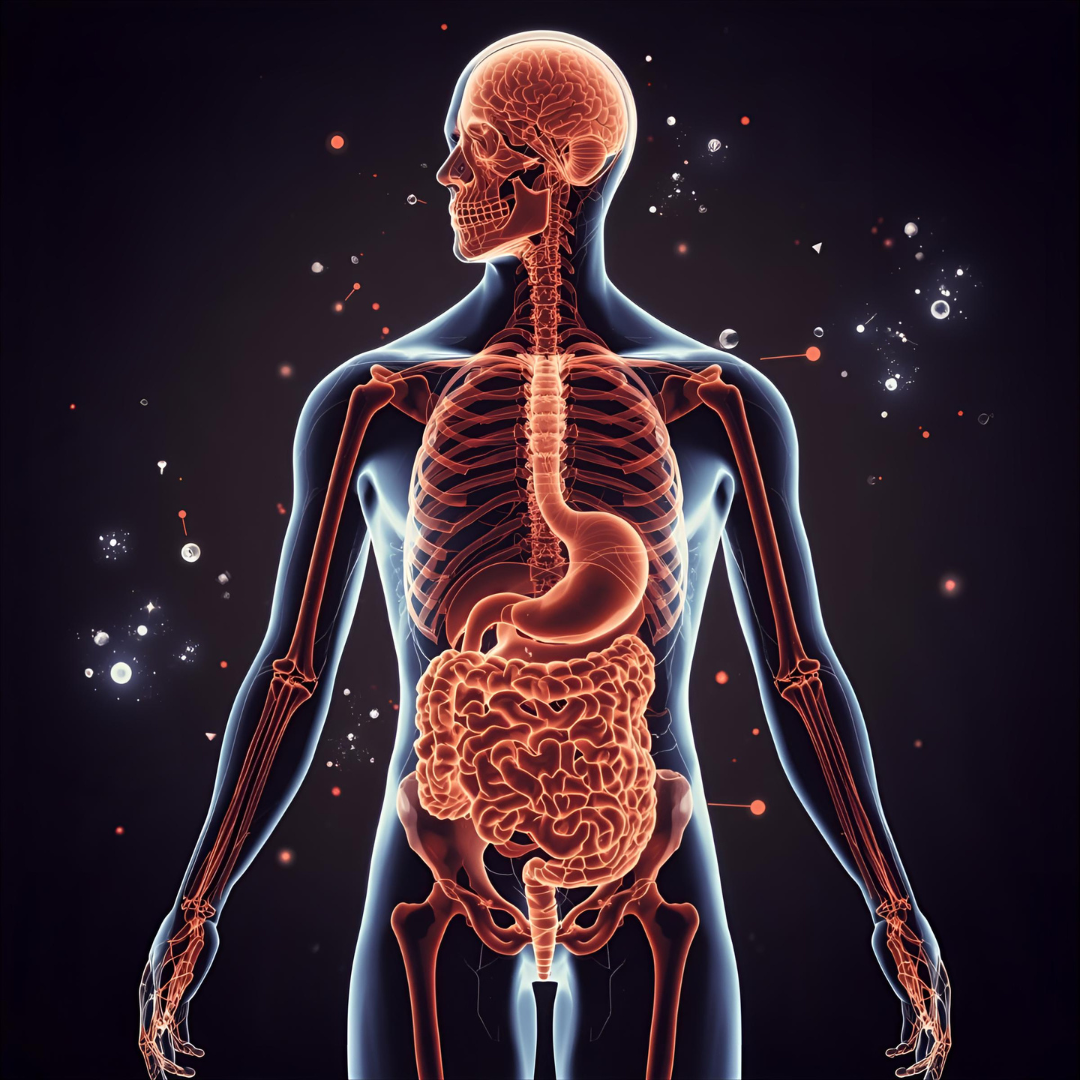
Research suggests that as much as 90% of the communication between the digestive system and the brain originates in the gut and moves to the brain.
IBS and the Vagus Nerve
Irritable Bowel Syndrome (IBS) is one of the most common examples of vagal imbalance.
Low vagal tone means weak signaling to the gut → sluggish motility, constipation, bloating, and pain.
Erratic vagal signaling can overstimulate the gut → spasms, cramping, and diarrhea.
Blood Sugar Swings and the Gut-Brain Axis
Blood sugar imbalances don’t just affect energy; they also disrupt vagal signaling between the gut and brain. When glucose levels spike and crash, the body releases stress hormones, including cortisol and adrenaline. These hormones activate the sympathetic nervous system and suppress the vagus nerve’s “rest-and-digest” functions. The result? Poor motility, disrupted gut flora, and more inflammation in the digestive tract.
Over time, this cycle can worsen IBS, reflux, and even conditions like dysbiosis or SIBO. Stabilizing blood sugar through balanced meals, avoiding excess refined carbs, and including protein and fiber helps the vagus nerve maintain steady communication, keeping both digestion and mood more stable.
Because the vagus nerve also regulates the stress response, many people with IBS experience anxiety as well. This isn’t just a coincidence. It’s the same nerve affecting both digestion and mood.
Beyond IBS: Other Bowel Conditions and the Vagus Nerve
IBS isn’t the only digestive issue tied to vagal tone. Other gut conditions may worsen when vagus nerve activity is disrupted:
Diverticulosis and Diverticulitis – Low vagal tone slows motility, leaving stool in the colon longer and increasing pressure. That stagnation can contribute to pouch formation (diverticulosis) and inflammation or infection (diverticulitis).
SIBO (Small Intestinal Bacterial Overgrowth) – The migrating motor complex (MMC), or the “cleaning wave” that sweeps bacteria out of the small intestine, is triggered by the vagus nerve. When vagal tone is weak, the MMC stalls, leading to bacterial overgrowth, gas, and pain.
Dysbiosis (Microbial Imbalance) – Gut microbes constantly send chemical messages that the vagus nerve carries to the brain. When those microbes are out of balance, vagal signaling carries “distress” messages upward, often showing up as IBS-like symptoms, fatigue, or even mood changes.
GERD (Reflux/Acid Indigestion) – The vagus nerve helps control the esophageal sphincter. Weak vagal tone can prevent this valve from closing properly, allowing stomach acid to flow back upward.
Inflammatory Bowel Disease (Crohn’s & Ulcerative Colitis) – The vagus nerve regulates the body’s “inflammatory reflex,” a pathway that calms immune overactivation. When vagal tone is low, inflammation rages unchecked, making flares more intense or prolonged.
These examples highlight a key truth: when vagal communication is disrupted, the gut struggles, no matter which diagnosis a person carries.
Supporting Gut-Brain Health Through the Vagus Nerve
Strengthening vagal tone is one of the most powerful ways to support digestion and overall well-being. Simple, natural strategies can make a big difference:
Deep, Diaphragmatic Breathing – Slow breathing directly stimulates the vagus nerve, calming the stress response and signaling the gut to move smoothly.
Mindful Eating – Taking time to chew thoroughly and eat in a relaxed state activates vagal signaling, boosting stomach acid, enzyme release, and peristalsis.
Probiotics and Prebiotics – A healthy microbiome communicates more effectively through the vagus nerve, reducing inflammation and improving mood.
Herbal and Nutritional Supports – Nervine herbs, digestive bitters, magnesium, and gemmotherapy calm the nervous system and help vagal signaling regulate gut activity more efficiently.
Gemmotherapy Remedies for Digestive Health & Vagus Nerve Support
Digestive support: Regulates gastric secretions, soothes reflux/GERD, eases spasms.
Vagus tie-in: Strongly harmonizes the gut-brain axis. Helps calm nervous tension, making it ideal when stress and anxiety trigger digestive symptoms like IBS.
2. Black Currant (Ribes nigrum)
Digestive support: Reduces inflammation in the gut (including gastritis, colitis, IBD).
Vagus tie-in: Stimulates adrenal-vagal communication, moderating inflammatory responses (“corticoid-like” effect without side effects).
Digestive support: Balances intestinal flora, useful for supporting the body when experiencing dysbiosis, diarrhea, and SIBO-type tendencies.
Vagus tie-in: Restores communication between microbiome and nervous system via vagal pathways.
4. Rosemary (Rosmarinus officinalis)
Digestive support: Improves sluggish liver and gallbladder function, supports motility.
Vagus tie-in: Stimulates the parasympathetic branch (liver/gut detox and regulation depend heavily on vagal signaling).
5. Silver Lime/Linden (Tilia tomentosa)
Digestive support: Relaxes spasms and regulates bowel motility.
Vagus tie-in: A nervous system stabilizer — helps restore vagal “tone” by calming sympathetic overdrive that worsens IBS.
IBS-Specific Gemmos (with vagus support built in)
Fig Tree → best known for supporting stress-induced IBS, reflux, and nervous stomach.
Walnut → best known for helping when dysbiosis, diarrhea, or microbiome imbalance are drivers.
Silver Lime/Linden → best known for cramping, spasms, and vagus-stress tension loops.
Listening to Your Gut and Your Vagus Nerve
Digestive symptoms are often the body’s way of signaling that vagal communication is off balance. By caring for the vagus nerve, we don’t just relieve bloating, reflux, or IBS symptoms; we restore the body’s natural ability to balance digestion, mood, and inflammation.
The vagus nerve is the thread that ties it all together: when it thrives, your gut and brain thrive too.
Resources
Bonaz, B., Bazin, T., & Pellissier, S. (2018). The vagus nerve at the interface of the microbiota–gut–brain axis. Frontiers in Neuroscience, 12, 49. https://doi.org/10.3389/fnins.2018.00049
Breit, S., Kupferberg, A., Rogler, G., & Hasler, G. (2018). Vagus nerve as modulator of the brain–gut axis in psychiatric and inflammatory disorders. Frontiers in Psychiatry, 9, 44. https://doi.org/10.3389/fpsyt.2018.00044
Ochoa-Repáraz, J., & Kasper, L. H. (2016). The second brain: Is the gut microbiota a link between obesity and central nervous system disorders? Current Obesity Reports, 5(1), 51–64. https://doi.org/10.1007/s13679-016-0191-1
Mayer, E. A., & Tillisch, K. (2011). The brain–gut axis in abdominal pain syndromes. Annual Review of Medicine, 62, 381–396. https://doi.org/10.1146/annurev-med-012309-103958
Furness, J. B., Callaghan, B. P., Rivera, L. R., & Cho, H. J. (2014). The enteric nervous system and gastrointestinal innervation: Integrated local and central control. Advances in Experimental Medicine and Biology, 817, 39–71. https://doi.org/10.1007/978-1-4939-0897-4_3
Bonaz, B., & Pellissier, S. (2021). The Vagus Nerve in the Neuro-Immune Axis: Implications in the Pathology of the Gastrointestinal Tract. Frontiers in Immunology, 12, 666331. https://doi.org/10.3389/fimmu.2021.666331
Pellissier, S., & Bonaz, B. (2017). The place of stress and emotions in the irritable bowel syndrome. Comptes Rendus Biologies, 340(4–5), 188–197. https://doi.org/10.1016/j.crvi.2017.02.006
Camilleri, M. (2019). Leaky gut: Mechanisms, measurement and clinical implications in humans. Gut, 68(8), 1516–1526. https://doi.org/10.1136/gutjnl-2019-318427
Tétau, M., & Scimeca, D. (2000). Gemmotherapy: Therapeutic Use of Buds. Rome: IPSA Editore.
Bergeret, J., & Tétau, M. (1997). Phytoembryotherapy: Embryonic Plant Extracts in Therapy. Rome: IPSA Editore.
Polari, L. (2019). Gemmotherapy and the gut-brain axis: An integrative approach to IBS and dysbiosis. Journal of Complementary Medicine Research, 10(2), 1–7.
Vannier-Santos, M. A., & Lenzi, H. L. (2017). Medicinal plants, polyphenols, and the modulation of intestinal microbiota and inflammation. Frontiers in Pharmacology, 8, 923. https://doi.org/10.3389/fphar.2017.00923
Tétau, M. (2005). Clinical applications of Ficus carica in psychosomatic disorders of the digestive system. Revue d’Homeopathie, 95(3), 145–152.
Rossi, E., & Bartoli, P. (2016). Herbal gemmotherapy in gastroenterology: Modulation of microbiota and motility. Phytotherapy Research, 30(12), 2016–2023. https://doi.org/10.1002/ptr.5759
Brigo, B. (2004). Phytotherapy and Gemmotherapy in Clinical Practice. Rome: IPSA Editore.
