Understanding Polyvagal Theory: How Your Vagus Nerve Shapes Stress, Safety, and Healing
Affiliate links are included in this blog. If you make a purchase using these links, I might earn a small commission at no extra cost to you. Win-Win!
When you think of your body’s stress response, you probably picture the classic “fight-or-flight” reaction. But science has shown us that there’s more to the story. Dr. Stephen Porges’ Polyvagal Theory has transformed our understanding of the nervous system, particularly the vagus nerve and its role in how we manage stress, connect with others, and heal.¹
The vagus nerve, also known as cranial nerve X, is the longest cranial nerve in the body. It runs from the brainstem through the neck and chest into the abdomen, touching nearly every major organ along the way.² It’s the main pathway of the parasympathetic nervous system, which regulates rest, digestion, immune function, and relaxation.³
Hyperarousal vs. Hypoarousal: When the Nervous System Loses Balance
When our nervous system is regulated, we can move fluidly between calm, alert, and restful states. But under stress, the system can get “stuck” in either hyperarousal (sympathetic overdrive) or hypoarousal (parasympathetic shutdown). Both patterns drain vitality and prevent the body from returning to balance.
Hyperarousal (fight, flight, or fawn) shows up as tension, anxiety, and over-activation. It’s the body on constant high alert.
Hypoarousal (freeze, shutdown, or collapse) shows up as withdrawal, fatigue, and disconnection. It’s the body conserving energy when the stress load feels overwhelming.
Beyond “Fight or Flight”
For years, the autonomic nervous system (ANS) was explained as two simple branches:
Sympathetic = fight or flight
Parasympathetic = rest and digest
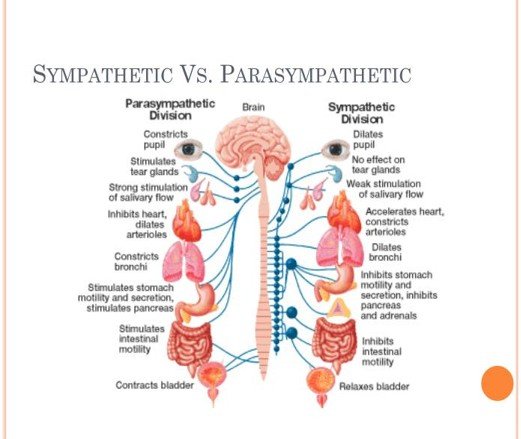
Image sourced HERE
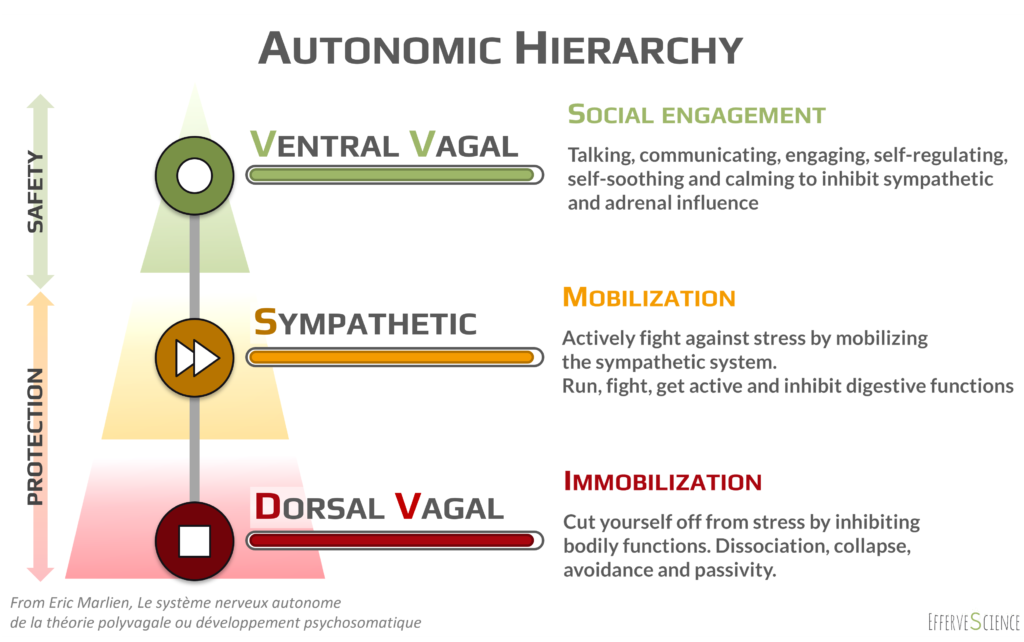
Polyvagal Theory expanded this understanding by showing that the vagus nerve has two different branches—ventral and dorsal—each with its own function. This creates three distinct states of response — connection, mobilization, and shutdown—that reflect how our bodies constantly adjust to stress, safety, and survival.¹
The ventral branch supports a state of safety and connection, allowing us to feel calm, engage socially, and think clearly. When challenges arise and we don’t feel safe, the sympathetic nervous system steps in, shifting us into fight-or-flight mode to help us react quickly. If the threat feels overwhelming and escape or defense isn’t possible, the dorsal branch takes over, pulling us into a shutdown state marked by disconnection, numbness, or exhaustion. These three distinct states of responses, connection, mobilization, and shutdown, reflect how our bodies constantly adjust to stress, safety, and survival.
Imagine walking in the woods: when you feel safe, you’re relaxed and enjoying the scenery (ventral state). If you suddenly hear rustling in the bushes, your body might tense and prepare to run (sympathetic state). But if a large predator appeared and escape felt impossible, your system could shut down, leaving you frozen or numb (dorsal state).
Ventral Vagal State: Safety and Connection
When the ventral vagus is active, you feel safe, calm, and socially connected.
Your body supports digestion, immune function, and healing.¹
You can make eye contact, express yourself clearly, and feel grounded in relationships.⁴
Sympathetic State: Fight or Flight
This state activates when you perceive danger.
Heart rate speeds up, breathing becomes shallow, muscles tense, and energy shifts toward survival.²
Helpful in emergencies, but harmful when stuck in this state chronically.
Dorsal Vagal State: Shutdown and Freeze
If the threat feels overwhelming and escape isn’t possible, the dorsal vagus takes over.¹
The body may “shut down”: slowed heart rate, fatigue, numbness, or even dissociation.⁵
It’s a protective mechanism, but if prolonged, it can contribute to depression, digestive issues, or chronic health challenges.
Why This Matters for Health
Polyvagal Theory helps explain why some people can handle stress and bounce back while others feel stuck in anxiety, exhaustion, or disconnection. It highlights the importance of vagal tone—how flexible and resilient the vagus nerve is.¹ Strong vagal tone allows the body to shift smoothly between states, while low vagal tone can leave a person trapped in survival modes.
Restoring vitality and harmony means supporting the nervous system’s flexibility so it can shift out of these extremes and back into balance.
Natural remedies—such as gemmotherapy (plant stem cell extracts that gently restore organ function) and aromatherapy (essential oils that directly influence the limbic system and vagus nerve)—can play an important role here. These therapies encourage the body to return to its natural rhythm, calming over-activation or gently lifting states of shutdown.
Vagal tone can also be improved through daily practices. As we’ve discussed in earlier blogs, gentle breathwork, humming or singing, cold exposure, and safe social connections are all shown to support healthy vagus nerve activity.⁶ Many holistic approaches—such as herbal support, bodywork, and mindfulness—also help restore balance.
The Takeaway
Gemmotherapy offers delicate, plant-based support for nervous system regulation in ways that echo the goals of Polyvagal Theory. Micro-dosing (1 to 3 drops) these gemmotherapy remedies has been known to help bring the nervous system back into a state of connection:
Silver Lime (Tilia tomentosa) “soothes the central nervous system,” aiding in reducing anxiety and promoting restful sleep for those who feel easily overwhelmed and disconnected.
White Willow (Salix alba) helps to “gather the scattered pieces of the emotional, mental, and physical self,” particularly under stress, facilitating a more organized and grounded internal state.
Dog Rose (Rosa canina), though primarily known as an immune tonic, is also described as “harmonizing for the central nervous system,” which supports a return to calm and resilience. It is especially helpful for those who feel fragile, ready to shatter or break easily.
Walnut (Juglans regia) is highlighted as a fast-acting central nervous system extract that helps shift the body from states of protection into deeper healing. Those needing Walnut might feel the best way to protect themselves is by being alone.
These are just a few of the many gemmotherapy extracts that offer gentle support, soothing hyperarousal, lifting hypoarousal, and anchoring the nervous system in the ventral vagal state of safety and connection.
Your nervous system is more than an on/off switch. Polyvagal Theory reveals the layered, intelligent ways your body responds to the world around you. Understanding these patterns helps us better care for ourselves and others—shifting from survival into healing, connection, and resilience.
References
Porges, S. W. (2011). The polyvagal theory: Neurophysiological foundations of emotions, attachment, communication, and self-regulation. New York, NY: W. W. Norton & Company.
Kandel, E. R., Schwartz, J. H., Jessell, T. M., Siegelbaum, S. A., & Hudspeth, A. J. (2013). Principles of neural science (5th ed.). New York, NY: McGraw-Hill.
Thayer, J. F., & Lane, R. D. (2009). Claude Bernard and the heart–brain connection: Further elaboration of a model of neurovisceral integration. Neuroscience & Biobehavioral Reviews, 33(2), 81–88. https://doi.org/10.1016/j.neubiorev.2008.08.004
Dana, D. (2018). The polyvagal theory in therapy: Engaging the rhythm of regulation. New York, NY: W. W. Norton & Company.
Schauer, M., & Elbert, T. (2010). Dissociation following traumatic stress: Etiology and treatment. Journal of Psychology, 218(2), 109–127. https://doi.org/10.1027/0044-3409/a000018
Gerritsen, R. J. S., & Band, G. P. H. (2018). Breath of life: The respiratory vagus nerve connection. Frontiers in Human Neuroscience, 12, 397. https://doi.org/10.3389/fnhum.2018.00397
(2015). Gemmotherapy: the power of buds. Retrieved from idee-fuer-mich.de
(n.d.). Silver Lime tree (Tilia tomentosa) BIO [Product page]. Aroma-Zen.
Hovis, B. (n.d.). White Willow (Salix alba). Sweet Herbin’ Livin’. Retrieved from sweetherbinlivin.com Sweet Herbin' Livin'
Gemmo Memo: Dog Rose – Gemmotherapy with Lauren Hubele. (2020, February 23). Retrieved from laurenhubele.com Gemmotherapy with Lauren Hubele
Gemmotherapy Nervous System Extracts – Earth Extracts. (n.d.). Retrieved from earthextracts.ca Earth Extracts
