The Vagus Nerve: How It Keeps Your Heart and Emotions in Balance
Affiliate links are included in this blog. If you make a purchase using these links, I might earn a small commission at no extra cost to you. Win-Win!
We’ve already explored the vagus nerve in earlier blogs, but today we’re diving into something more personal: how this nerve connects not only to your heart health but also to your emotional balance.
The Vagus Nerve’s Role in HRV
The vagus nerve is like the body’s built-in calming switch. It carries the signals of your parasympathetic nervous system — the “rest and digest” branch — telling your body it’s safe to relax.
When it talks to your heart, the vagus nerve acts like a brake pedal, gently adjusting your heart rate to match what’s happening around you. This adaptability shows up as Heart Rate Variability (HRV), the tiny changes in time between heartbeats.
When HRV is high, you’re not only more physically resilient, but also more emotionally flexible. You can shift out of stress, recover from setbacks, and stay calm in conversations instead of snapping. When HRV is low, you’re more likely to feel stuck in fight-or-flight mode, easily overwhelmed, anxious, or emotionally flat.
What Exactly Is HRV?
HRV is the scientific term for how much variety shows up in the timing of your heartbeats. Your heart doesn’t tick like a metronome, and that’s a good thing. In fact, if your heart were as steady as a metronome, beat, beat, beat, with no variation, that would be a red flag. A healthy, responsive system has some wiggle room. For example:
When you take a deep breath in, your heart naturally speeds up a bit.
When you breathe out, it slows down.
This slight back-and-forth rhythm is your vagus nerve at work, helping your body adjust to what’s happening in the moment. That flexibility, what scientists call heart rate variability (HRV), is what tells us your body is resilient and ready to bounce back from stress.
Higher HRV = Your nervous system is adaptable. Physically, that means quicker recovery from stress or exercise. Emotionally, it means you can move from frustration to calm, or sadness to hope, more smoothly.
Lower HRV = Your system is rigid. Physically, that’s linked with stress overload and a higher risk for heart issues. Emotionally, it’s tied to anxiety, burnout, and trouble bouncing back from challenges.
In short: HRV isn’t just about your heart — it’s a window into your mind-body connection.
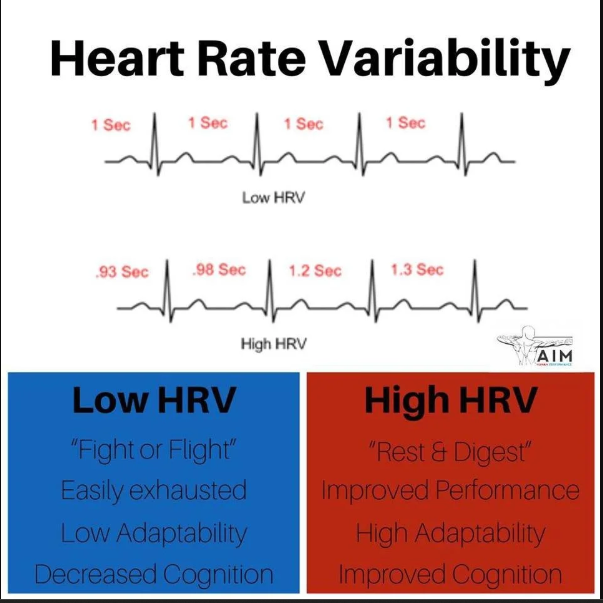
Image sourced from Confluence Coach.
What Happens When the Vagus Nerve Struggles?
When the vagus nerve isn’t firing well, you may notice both physical and emotional ripple effects:
Heart issues: skipped beats, fainting spells (vasovagal syncope), or poor adaptation to stress.
Stress overload: feeling “stuck on high alert,” racing thoughts, or not being able to wind down.
Digestive troubles: since the vagus nerve also controls gut function, you might notice bloating, reflux, or sluggish digestion.
Emotional struggles: low vagal tone makes it harder to regulate feelings — leaving you quick to anger, easily anxious, or emotionally disconnected from others.
In many ways, your vagus nerve is the bridge between your body’s rhythms and your emotional steadiness.
The “Nerve of Compassion”
You may have heard the vagus nerve called the “nerve of compassion.” This comes from Dr. Stephen Porges’s Polyvagal Theory, which shows how one branch of the vagus nerve (the ventral vagus) supports safety, trust, and social bonding.
Other researchers, like Barbara Fredrickson, have shown that practicing compassion and kindness actually improves vagal tone. It works in both directions: the healthier your vagus nerve, the easier it is to feel safe, compassionate, and connected, and the more you practice compassion, the stronger your vagus nerve becomes.
How to Support Your Vagus Nerve & HRV Naturally
In our first vagus nerve article, we explored simple practices like deep breathing, cold exposure, and mindfulness that help strengthen vagal tone. In our second blog, we discussed Polyvagal Theory and a few gemmotherapy remedies that can restore a state of connection and support and nurture the vagus nerve.
In this article, let’s go a step further and look at some aromatherapy and gemmotherapy remedies that specifically support vagus nerve health.
Essential Oils
Essential oils can be powerful allies for calming the nervous system and encouraging parasympathetic activity:
Lavender – widely studied for its calming effect on the nervous system; helps reduce anxiety and supports sleep.
Frankincense – grounding and balancing, often used to ease tension and deepen breathing.
Bergamot – uplifting yet soothing, often recommended for stress and mood regulation.
Roman Chamomile – supports both digestion and relaxation, a gentle way to ease vagal stress responses.
Try diffusing these oils, adding a drop to a carrier oil for neck or chest massage, or simply inhaling directly from the bottle during moments of stress. To learn how to safely use and dilute essential oils, check out my Aromatherapy page.
Gemmotherapy Remedies
Gemmotherapy uses extracts from young plant buds and shoots, rich in growth factors that support organ and nervous system repair. For vagus nerve support, consider:
Fig (Ficus carica) – harmonizes the nervous system and eases anxiety. Fig is particularly supportive for the digestive tract, especially when stress or emotional tension shows up as stomach discomfort, bloating, reflux, or irregular digestion. By calming the gut-brain axis and reducing stress-driven digestive upset, Fig helps keep the vagus nerve responsive and resilient, which in turn supports healthier heart rate variability, mood regulation, and digestion.
Lime Tree aka Silver Linden (Tilia tomentosa) – calming to both heart and nerves, helps regulate sleep and reduce stress. Lime is a nervous system and circulation tonic, supporting emotional balance, easing tension, and is often used in cases of nervous exhaustion.
Black Currant Ribes nigrum - acts as a natural adaptogen, helping the body handle stress and regulate the nervous system. Supports adrenal balance, which ties into vagus nerve resilience (less “fight or flight” dominance). Provides gentle anti-inflammatory effects, calming the nervous system and improving overall tone.
Hawthorn (Crataegus oxyacantha) – strengthens the heart, balances rhythm, and supports circulation, making it a key ally for vagal-heart connection.
These remedies work gently but deeply, helping the nervous system regain its rhythm and balance.
Putting It All Together
Your vagus nerve is more than anatomy — it’s your built-in bridge between heart health and emotional well-being. By caring for it, you’re not only supporting your body’s stress recovery but also strengthening your capacity for calm, compassion, and connection.
That’s why it truly deserves its nickname: the nerve of compassion.
References
Shaffer, F., & Ginsberg, J. P. (2017). An Overview of Heart Rate Variability Metrics and Norms. Frontiers in Public Health, 5, 258. https://doi.org/10.3389/fpubh.2017.00258
Thayer, J. F., Åhs, F., Fredrikson, M., Sollers III, J. J., & Wager, T. D. (2012). A meta-analysis of heart rate variability and neuroimaging studies: Implications for heart rate variability as a marker of stress and health. Neuroscience & Biobehavioral Reviews, 36(2), 747–756. https://doi.org/10.1016/j.neubiorev.2011.11.009
Lehrer, P. M., & Gevirtz, R. (2014). Heart rate variability biofeedback: How and why does it work? Frontiers in Psychology, 5, 756. https://doi.org/10.3389/fpsyg.2014.00756
Laborde, S., Mosley, E., & Thayer, J. F. (2017). Heart Rate Variability and Cardiac Vagal Tone in Psychophysiological Research – Recommendations for Experiment Planning, Data Analysis, and Data Reporting. Frontiers in Psychology, 8, 213. https://doi.org/10.3389/fpsyg.2017.00213
Panossian, A., & Wikman, G. (2010). Effects of adaptogens on the central nervous system and the molecular mechanisms associated with their stress-protective activity. Pharmaceuticals, 3(1), 188–224. https://doi.org/10.3390/ph3010188
Tétreault, É., Pilote, S., & Rhainds, D. (2012). Fig tree bud extract (Ficus carica) in clinical practice: A gemmotherapy overview. Phytothérapie, 10(6), 331–334. https://doi.org/10.1007/s10298-012-0744-4
Mondal, S., Varma, S., Bamola, V. D., Naik, S. N., Mirdha, B. R., Padhi, M. M., & Mediratta, P. K. (2011). Double-blinded randomized controlled trial for immunomodulatory effects of Tulsi (Ocimum sanctum Linn.) leaf extract on healthy volunteers. Journal of Ethnopharmacology, 136(3), 452–456. https://doi.org/10.1016/j.jep.2011.05.006
